One-off archive destruction: when do you need it, how does it work and what does it cost?
There is a moment every company knows: the archive room is full, storage costs are rising, or an office move is planned. At that moment the question arises: what should we actually do with all that paper? Which files must we keep, which may go and if they may go, how?
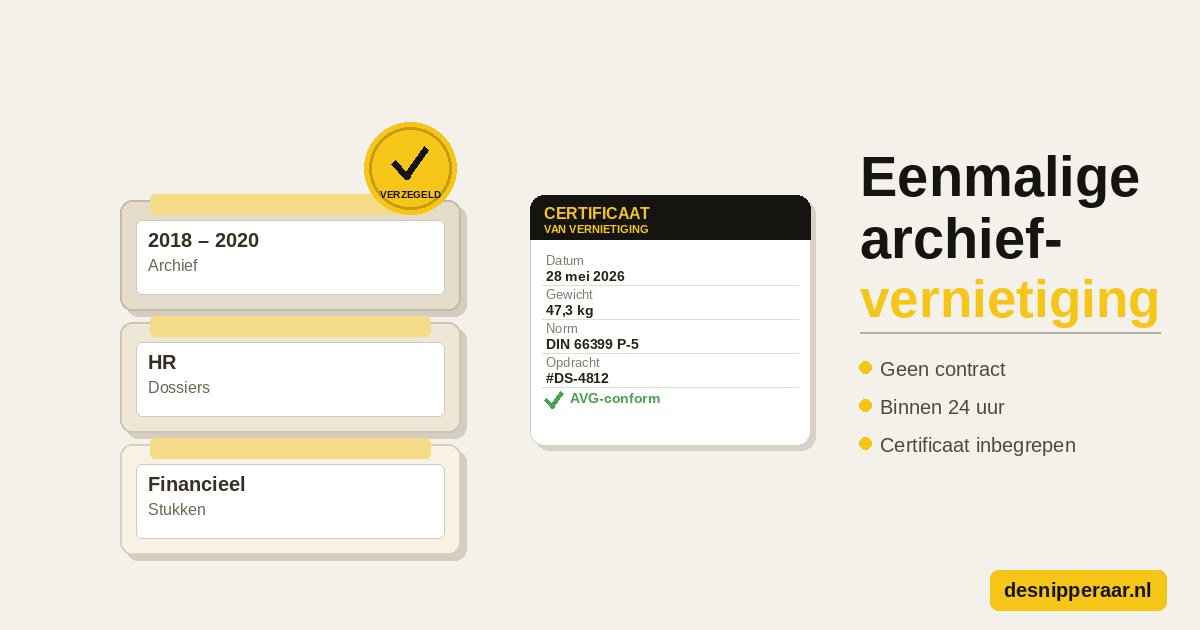
One-off archive destruction is the most common solution. No contract, no fixed service, you arrange it once, properly, with a certificate as proof and you have nothing to worry about for years.
This article explains how you determine when you need it, how you prepare well, what is needed on your side and what it realistically costs.
When do you need one-off archive destruction?
There are five situations that recur periodically at almost every company:
1. Retention periods have expired
The most common reason. Tax records may be kept for 7 years (see GDPR retention periods cheat sheet), payroll records 7 years, personnel data 2 to 7 years depending on the type. Once that period is over, your retention obligation turns into an obligation to destroy. Acting on it is not an option, it is a duty.
2. Office move
You are moving and do not want to take boxes of old paper to the new location. Read also our article office move: what do you take, what do you destroy? Moving is the ideal moment for a thorough archive clean-up. Fewer boxes means lower moving costs, less storage space needed at the new location and less GDPR risk.
3. Acquisition or merger
In an acquisition or merger, archives of several parties are brought together. Files not carried over into the new organisation must be destroyed in a demonstrable way, for both legal and privacy certainty.
4. Business closure or retirement
If you stop your business, the files do not simply go in the bin. Client files, personnel files and financial records must be destroyed GDPR-compliant. A certificate is recommended at business closure too.
5. Periodic archive clean-up
Sometimes an organisation has done nothing with its archive for years. A one-off effort to sort everything and throw away what is allowed, separate from a fixed destruction contract, is then the most pragmatic approach.
What should you find out in advance?
Good preparation saves time, money and discussion during the job. You do not, however, have to work everything out to the last detail.
Needed
- An estimate of the volume, how many boxes, how many folders, how many archive cabinets? An archive box holds approx. 15 kg of paper, a standard folder approx. 1 kg. You do not need to count: a rough estimate is enough.
- A main distinction: what may go and what may not? Determine per category (annual accounts before year X, client files older than Y years) where the line is.
- Do you know there are data carriers included? Hard drives, USB sticks or backup tapes require separate handling and their own price.
Not needed
- You do not need to unpack folders or remove paper clips.
- You do not need to weigh boxes, your destruction company weighs at collection.
- You do not need to check the content page by page.
Not sure how much paper you have? Our rules of thumb in how much paper is in a filing cabinet? help you make a reliable estimate.
How does one-off archive destruction work in practice?
Step 1. Request and quote
You state how much volume (boxes, containers, cabinets) there is and whether data carriers are included. A good provider gives you a fixed price, no time-and-materials billing.
Step 2. Planning
You agree a collection date and time window. You or a colleague is present.
Step 3. Sealed collection
The boxes or roll container are sealed and weighed at collection. The seal number is on the collection note, that is the first piece of evidence in the chain.
Step 4. Transport and destruction
Your material is transported sealed to the destruction site. With a reliable party, destruction takes place within 24 hours, no lengthy interim storage. Read more about the full transport and evidence process in chain of custody: who touches your archive?.
Step 5. Certificate
Within two working days you receive a Certificate of Destruction with date, weight, order number and the applied DIN level. You keep that certificate in your GDPR file.
What does one-off archive destruction cost?
Price overview (excl. 21% VAT)
| Your volume | Per box | Per roll container | Cheapest choice |
|---|---|---|---|
| 1 box | € 30 | n/a | Per box |
| 3 boxes | € 80 | € 120 (1 container) | Per box |
| 6 boxes | € 155 | € 165 (2 containers) | Per box |
| 7 boxes | € 180 | € 165 | Per container |
| 12 boxes | € 305 | € 210 (3 containers) | Per container |
Rule of thumb: Fewer than seven boxes? Go for per-box collection. Seven or more? Then a roll container pays off.
Data carriers separately
Hard drives, USB sticks, SSDs and backup tapes are priced separately per unit, with serial-number registration on the certificate.
One-off or recurring? Making the right choice
- Fewer than three boxes per year: One-off on request is cheaper. No fixed costs.
- Three to ten boxes per quarter: A fixed collection frequency saves planning and gives certainty.
- More than ten boxes per month: A structural service with fixed containers is then more efficient.
In doubt? In recurring destruction or one-off? we set out the trade-off per organisation size.
What if there are also hard drives or data carriers?
Archive boxes and hard drives are processed in the same visit, but handled differently. Each drive is registered by serial number, priced separately and listed separately on the certificate. Serial-number registration is often required by the leasing company in an IT audit or lease return.
More on the method: how is a hard drive actually shredded?
Ready for a collection?
Call us for a fixed price within 5 minutes, or request a quote directly. No call-out charges within 20 km of Amsterdam, no contract, a certificate with every order.
Request a quoteFrequently asked questions
How long before my material is destroyed?
With a reliable party, at most 24 hours after collection. The certificate follows within 2 working days. Need it faster? Read about urgent destruction: when and how.
Do I have to unpack folders or remove paper clips?
No. An industrial shredder processes folders, paper clips, ring binders and plastic sleeves without preparation.
How do I prove the destruction took place for an audit?
With the Certificate of Destruction you receive after the order. Keep it at least 5 years in your GDPR file.
Can I also have paper collected at home for one-off destruction?
Yes. Private individuals pay the same rates as business clients. When moving, dealing with an estate or clearing an attic, a home collection is possible.
Do I have to sign a contract for one-off destruction?
No. One-off orders work without a contract or minimum purchase.
Do I have to be present at the collection?
You or a colleague must be available to receive and sign the collection note.
What does it cost if I have more boxes than stated in advance?
Extra boxes in the same collection cost the standard extra rate. You decide on the spot whether to hand them over.
Conclusion
One-off archive destruction is for most SMEs the most practical route to clear an accumulated archive GDPR-compliant. No contract, no fixed costs and, after the job, a certificate that proves it was done properly.
The preparation costs you an hour at most. The rest is done by your destruction party.
Ready for a collection? Call us for a fixed price within 5 minutes, or request a quote via desnipperaar.nl.